Efecto de la procedencia de Macrobrachium tenellum (Decapoda: Palaemonidae) sobre su crecimiento, sobrevivencia y actividad digestiva
Actividad digestiva de Macrobrachium tenellum
DOI:
https://doi.org/10.60158/3bwks511Palabras clave:
actividad digestiva, acuacultura, dietas, langostinoResumen
Resumen
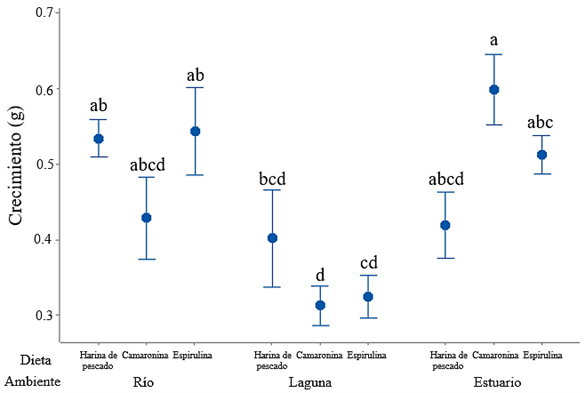
El langostino Macrobrachium tenellum (Smith 1871) es fuente de alimento para las comunidades costeras de México. En el Pacífico mexicano sus poblaciones se distribuyen en lagunas costeras, estuarios y ríos. Recientemente se ha generado información sobre propuestas alimenticias para el langostino M. tenellum en condiciones de cultivo, pero es necesario entender la maquinaria digestiva. El objetivo de este trabajo fue evaluar el efecto de las procedencias de colecta de juveniles de langostinos en parámetros productivos y actividad enzimática. Entre febrero y marzo del 2024 langostinos juveniles fueron recolectados en río, laguna y estuario de la cuenca de Colotepec. Se estableció un experimento bajo un diseño completamente aleatorizado con un arreglo factorial tres por tres, proporcionándoles tres dietas. Los parámetros fueron registrados cada 15 días durante dos meses y la actividad enzimática fue determinada mediante técnicas espectrofotométricas de microplaca. Los datos se analizaron mediante un análisis de varianza y prueba de medias de Tukey. Se encontraron diferencias significativas (p < 0.05) sobre el crecimiento y sobrevivencia, siendo los organismos del río quienes presentaron los mayores valores. Las lipasas, tripsina y leucina aminopeptidasa presentaron diferencias significativas (p < 0.05) en cuanto al origen de los organismos y el tiempo de cultivo.
Descargas
Referencias
Alexandre, D., Ozorio, R.A., Derner, R.B., Fracalossi, D.M., Oliveira, G.B., Samuels R.I. & Silva, C.P. (2014). Spatial distribution of digestive proteinases in the midgut of the Pacific white shrimp (Litopenaeus vannamei) indicates the existence of endoectoperitrophic circulation in Crustacea. Comparative Biochemistry and Physiology Part B, 172, 90–95. 10.1016/j.cbpb.2014.04.010
Amaya, E., Davis, A. & Rouse D. (2007). Replacement of fish meal in practical diets for the Pacific white shrimp (Litopenaeus vannamei) reared under pond conditions. Aquaculture, 262, 393-401. https://doi.org/10.1016/j.aquaculture.2006.11.015
Badillo-Zapata, D., Vega-Villasante, F., Nolasco-Soria, H., López-Acuña, L., Vargas-Ceballos, M., & Barreto-Curiel, F. (2023). Replacement of fishmeal by hydrolyzed feather meal in diets of juvenile Macrobrachium tenellum (river prawns) and its effect on muscle fatty acids. Latin American Journal of Aquatic Research, 51(5), 703-716. http://dx.doi.org/10.3856/vol51-issue5-fulltext-3030
Bradford, M. (1976). A rapid and sensitive method for the quantitation of microgram quantities of protein utilizing the principle of protein-dye binding. Analytical Biochemistry, 72: 248–254. https://doi.org/10.1016/0003-2697(76)90527-3
Ceballos, J.B., Hernández-Llamas, A., García-Galano, T. & Villarreal, H. (2006). Substitution of Chaetoceros muelleri by Spirulina platensis meal in diets for Litopenaeus schmitti larvae. Aquaculture, 260, 215–220. https://doi.org/10.1016/j.aquaculture.2006.06.002
Cortés-Jacinto, E., Villarreal, H., Civera-Cerecedo, R. & Martínez-Córdova, R. (2003). Effect of dietary protein level on growth and survival of juvenile freshwater crayfish Cherax quadricarinatus (Decapoda: Parastacidae). Aquaculture Nutrition, 9, 207–213. https://doi.org/10.1046/j.1365-2095.2003.00241.x
Cortés-Jacinto, E., Villarreal, H., Civera-Cerecedo, R. & Naranjo, J. (2004). Effect of dietary protein level on the growth and survival of pre-adult freshwater crayfish Cherax quadricarinatus (von Martens) in monosex culture. Aquaculture Research, 35, 71–79. https://doi.org/10.1111/j.1365-2109.2004.00988.x
Da Silva Santos, F.M., Ribeiro, K., Freitas, V., Carvalho, L.B., Valenti, W.C. y de Souza Bezerra, R. (2016). Digestive proteases from wild and farmed male morphotypes of the Amazon River prawn (Macrobrachium amazonicum). Journal of Crustacean Biology, 34, 189–198. https://doi.org/10.1163/1937240X-00002215
De los Santos-Romero, R.B., Peña, E., Álvarez-González, C.A., Cruz-Ramírez, F., López-Vásquez, J. & García-Guerrero, M. (2020). Differences in enzymatic activity in wild long-arm river prawns, Macrobrachium tenellum (Smith, 1871) (Decapoda: Caridea: Palaemonidae), from different habitats. Journal of Crustacean Biology, 40, 455–461. https://doi.org/10.1093/jcbiol/ruaa035
De los Santos-Romero, R. B., Vega-Villasante, F., Cortés-Jacinto, E. & García-Guerrero, M. (2021). The culture potential and management problems of freshwater prawns (Macrobrachium americanum and Macrobrachium tenellum) in their native areas: the case for Mexico. Latin American Journal of Aquatic Research, 49(3), 376-390. https://dx.doi.org/10.3856/vol49-issue3-fulltext-2625
De los Santos-Romero, R. B., Álvarez-González, C.A., Peña, E., Cortés J. E., Hernández, L.H. & García-Guerrero, M. (2022). Variations of digestive enzymatic activity of the longarm river prawn, Macrobrachium tenellum (Smith 1871) adapted from the wild to culture with prepared meals. Journal of the World Aquaculture Society, 53, 681–692. https://doi.org/10.1111/jwas.12847
Erlanger, B., Kokowsky, N. & Cohen, W. (1961). The preparation and properties of two new chromogenic substrates of trypsin. Archives of Biochemistry and Biophysics, 95, 271–278. https://doi.org/10.1016/0003-9861(61)90145-X
Espinosa-Chaurand, L.D., Vega-Villasante, F., Carrillo-Farnés, O. & Nolasco-Soria, H. (2017). Effect of circadian rhythm, photoperiod, and molt cycle on digestive enzymatic activity of Macrobrachium tenellum juveniles. Aquaculture, 479, 225–232.
Espinosa-Chaurand, L.D., Carrillo-Farnés, O., Vega-Villasante, F. & Nolasco-Soria, H. (2019). Effect of protein level in diet and feeding schedule on the digestive enzymatic activity of Macrobrachium tenellum juveniles. Latin American Journal of Aquatic Research, 47, 743–752. http://dx.doi.org/10.3856/vol47-issue5-fulltext-3
Fernández-Gimenez, A. (2013). Digestive physiology of three species of decapod crustaceans of Argentina. Journal of Shellfish Research, 32(3), 767–777. https://doi.org/10.2983/035.032.0320
García-Guerrero, M., Becerril-Morales, F., Vega-Villasante, F. & Espinosa-Chaurand, L.D. (2013). Los langostinos del género Macrobrachium con importancia económica y pesquera en América Latina: conocimiento actual, rol ecológico y conservación. Latin American Journal of Aquatic Research, 41, 651–675. http://dx.doi.org/103856/vol41-issue4-fulltext-3
Gutiérrez-Méndez, I., Rodríguez-Magadan, H., Martínez-Salazar, N., García-Guerrero, M. & De los Santos-Romero, R. (2024). Populational differences in freshwater prawn Macrobrachium tenellum Smith (Decapoda: Palaemonidae) from three river basins of Oaxaca, Mexico, determined with microsatellite markers. Latin American Journal of Aquatic Research, 52(4), 595-604. https://dx.doi.org/10.3856/vol52-issue4-fulltext-3182
Hernández-Hernández, L. H., Powell, M. S., Frías-Gómez, S. A., Cortés-Jacinto, E. & Vega-Villasante, F. (2024). Scientific knowledge of the cinnamon river prawn Macrobrachium acanthurus and future perspectives for aquaculture. Aquaculture International, 32, 10215–10230. https://doi.org/10.1007/s10499-024-01658-2
Lancia, J.A., Fernández-Gimenez, C., Bas, C. & Spivak, E. (2012). Adaptive differences in digestive enzyme activity in the crab Neohelice granulata in relation to sex and habitat. Journal of Crustacean Biology, 32, 940–948. https://doi.org/10.1163/1937240X-00002090
Lima, J. D. F., Garcia, J. D. S. & Silva, T. C. D. (2014). Natural diet and feeding habits of a freshwater prawn (Macrobrachium carcinus: Crustacea, Decapoda) in the estuary of the Amazon River. Acta Amazonica, 44, 235-244. https://doi.org/10.1590/S0044-59672014000200009
Linton, S., Saborowski, M. R., Shirley, A. J. & Penny, J. A. (2014). Digestive enzymes of two brachyuran and two anomuran land crabs from Christmas Island, Indian Ocean. Journal of Comparative Physiology B, 184, 449–468. https://doi.org/10.1007/s00360-014-0815-2
Manríquez-Santos, T. D. J., Álvarez-González, C. A., Peña, E., Camarillo-Coop, S., Martínez-García, R., & Vega-Villasante, F. (2018). Partial characterization of digestive proteases in adults of bigclaw river shrimp Macrobrachium carcinus. Latin American Journal of Aquatic Research, 46(3), 525-533. https://doi.org/10.3856/vol46-issue3-fulltext-5
Maraux, S., Louvard, D. & Baratti, J. (1973). The aminopeptidase from hogintestinal brush border. Biochemistry and Biophysics Acta, 321, 282–295. https://doi.org/10.1016/0005-2744(73)90083-1
Méndez-Martínez, Y., Torres-Navarrete, Y. G., Cortés-Jacinto E., García-Guerrero, M. U., Hernández-Hernández, L. H. & Verdecia. D. M. (2022). Biological, nutritional, and hematoimmune response in juvenile Cherax quadricarinatus (Decapoda: Parastacidae) fed with probiotic mixture. Revista MVZ Cordoba, 27(3). https://doi.org/10.21897/rmvz.2578
Mustafa, M.G., Wakamatsu, S., Takeda, T., Umino, T. & Nakagawa, H. (1995). Effect of algae as a feed additive on growth performance in red sea bream, Pagrus major. Trace Nutrients Research, 12, 67–72.
Musin, G., Rossi, A., Diawol, V.P., Collins, P.A. & Williner, V. (2018). Development of enzymes during ontogeny of two freshwater Decapoda: Aegla uruguayana (Aeglidae) and Macrobrachium borellii (Palaemonidae). Aquaculture Research, 49, 3889–3897. https://doi.org/10.1111/are.13858
Pérez-Chabela, M.L., Alvarez-Cisneros, Y.M., Soriano-Santos, J. & Pérez-Hernández, M.A. (2020). Los probióticos y sus metabolitos en la acuicultura. Una Revisión. Hidrobiológica, 30 (1), 93-105. https://doi.org/10.24275/uam/izt/dcbs/hidro/2020v30n1
Peña-Almaraz, O. A., Castillo-Jiménez, H. E., Vargas-Ceballos, M. A., Badillo-Zapata, D., Chong-Carrillo, O. & Vega-Villasante, F. (2024). A life controlled by the current: rheotaxis behavior of the river prawn Macrobrachium tenellum (Decapoda: Palaemonidae). Revista de Biología Tropical, 72(1), e56514. https://dx.doi.org/10.15517/rev.biol.trop..v72i1.56514
Rahim, A., Cakir, C., Ozturk, M., Sahin, B., Soulaimanid, A., Sibaoueih, A., Nasser, B., Essamadi, R. & El Amiri, B. (2021). Chemical characterization and nutritional value of Spirulina platensis cultivated in natural conditions of Chichaoua region (Morocco). South African Journal of Botany, 141, 235–242. https://doi.org/10.1016/j.sajb.2021.05.006
Rojo-Arreola, L., Choquet, C., Cordova-Murueta, J. & Garcia-Carreno, F. (2019). The protease-based compensatory mechanism to minimize the effect of dietary Soybean Trypsin Inhibitor in Litopenaeus vannamei. Aquaculture, 500, 18–23. https://doi.org/10.1016/j.aquaculture.2018.10.002
Stumpf, L., Timpanaro, S., Battista, A., & López Greco, L. (2020). Effects of intermittent starvation on the survival, growth, and nutritional status of the freshwater prawn Macrobrachium borellii Nobili, 1896 (Decapoda: Caridea: Palaemonidae). The Journal of Crustacean Biology, 40(5), 489-497. https://doi.org/10.1093/jcbiol/ruaa051
Vargas-Ceballos, M.A., Badillo-Zapata, D., Chong-Carrillo, O., Ponce-Palafox, J.T., Hernandez-Hernandez, L.H. & Vega-Villasante, F. (2020). Intake of different food sources in the first zoeae stages of Macrobrachium tenellum (Decapoda: Palaemonidae). Latin American Journal of Aquatic Research, 48, 156–161. http://dx.doi.org/10.3856/vol48-issue1-fulltext-2344
Vargas-Ceballos, M.A., Wehrtmann, I.S., López-Uriarte, E., Vega-Villasante, F., Peña-Almaraz, O., Espinosa-Magaña, A.F. & García-Guerrero, M.U. (2024). Population structure and abundance of the amphidromous prawn Macrobrachium tenellum (Smith, 1871) (Decapoda: Caridea: Palaemonidae) in the lower basin of Ameca River, western Mexico, before anthropogenic modifications. Journal of Crustacean Biology, 44(1), ruae012. https://doi.org/10.1093/jcbiol/ruae012
Versaw, W., Cuppet, S. & Winters, D.W. (1989). An improved colorimetric assay for bacterial lipase in nonfat dry milk. Journal of Food Science, 54, 1365–2621. https://doi.org/10.1111/j.1365-2621.1989.tb05159.x
Archivos adicionales
Publicado
Número
Sección
Licencia
Derechos de autor 2025 Revista mexicana de agroecosistemas

Esta obra está bajo una licencia internacional Creative Commons Atribución-NoComercial 4.0.
La revista utiliza la versión CC BY-NC 4.0 del Creative Commonds, donde el usuario es libre de compartir, copiar y redistribuir el material en cualquier medio o formato; adaptar, remezclar, transformar y construir a partir del material. Estas libertades se sujetan a los términos siguientes.
- Atribución, los autores conservarán el reconocimiento moral de su obra y serán identificados como responsables intelectuales de los trabajos publicados. Al aceptar la publicación, los autores otorgarán a la RMAE los derechos necesarios para la edición, publicación, difusión, preservación digital e indexación de los trabajos, manteniendo siempre el reconocimiento de autoría correspondiente.
- Los materiales publicados podrán utilizarse libremente para fines no comerciales, incluyendo: docencia y actividades educativas, investigación científica y tecnológica, elaboración de tesis, proyectos académicos y trabajos de divulgación, capacitación profesional, consulta institucional y preservación digital y de archivos.
- No se permitirá que los contenidos sean utilizados con fines comerciales directos o indirectos sin autorización previa y por escrito de la revista y de los titulares de los derechos correspondientes. Se consideran usos comerciales: venta de artículos o compilaciones, inclusión del contenido en productos o servicios de pago, comercialización de bases de datos que incorporen los materiales publicados, uso publicitario o promocional con fines lucrativos, entre otros.
- Toda reutilización de los contenidos deberá: citar adecuadamente a los autores y debe incluir el título del artículo, mencionar el nombre de la revista, incorporar el volumen, número, año, DOI y mantener la referencia a la publicación original. La omisión deliberada de la atribución correspondiente constituirá una violación a los derechos de autor y a la ética académica de la revista.
- El usuario acepta y acuerda estar obligado por los términos y condiciones de esta Licencia Internacional Pública de Atribución/Reconocimiento-NoComercial 4.0 de Creative Commons ("Licencia Pública").
- La revista utiliza el accesoabierto gratuito y no restringido por suscripción. De tal manera, que se pone a disposición de los autores, los metadatos, bases de datos, datos de descarga, uso y citación para facilitar su disponibilidad a las herramientas informáticas que calculan las métricas alternativas del impacto.
- Se aplican buenas prácticas del uso del Open Journal System de acuerdo al “Manual de indización en OJS: buenas prácticas para la región latinoamericana”, 2ª. edición (Flores-Chávez et al., 2023).
- En caso de existir una impugnación con el contenido o la autoría del manuscrito, la responsabilidad -económica y jurídica- será exclusivamente de los autores, relevándola del Tecnológico Nacional de México, Campus Valle de Oaxacay de la Revista Mexicana de Agroecosistemas, ante cualquier demanda o reclamación que llegase a formular alguna persona física o moral que se considere con derecho sobre el manuscrito.
- Los nombres y las direcciones de correo electrónico introducidos en esta revista se usarán exclusivamente para los fines establecidos en ella y no se proporcionarán a terceros o para su uso con otros fines.
Cómo citar