Presencia de un hongo neopestalotioide responsable de pudrición y muerte en plantaciones de fresa: una revisión
CTV aplicado en producción de crisantemo
DOI:
https://doi.org/10.60158/6q412746Palabras clave:
base de datos, género, manejo integrado, metabolitos, patógenoResumen
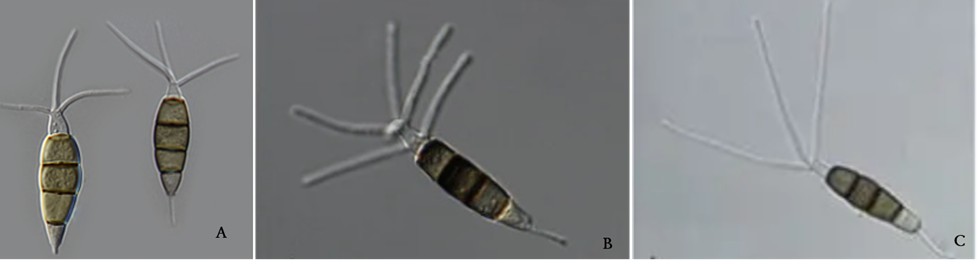
El cultivo de fresa sobresale por considerarse una frutilla de alto contenido nutrimental para el humano, en los últimos años este cultivo ha manifestado problemas sanitarios asociados a la presencia de un hongo neopestalotioideo del género Neopestalotiopsis, el cual es de reciente emergencia, provoca pudriciones de frutos, corona y raíz, además de tizones foliares en hojas y peciolos de la planta hasta causar la muerte de la misma, algunas especies responsables ya han sido identificadas. Se realizó una revisión exhaustiva de la bibliografía relacionada al hongo Neopestalotiopsis sp., se analizaron y seleccionaron artículos científicos encontrados en bases de datos como Scopus, Web of Science, PubMed, Google Scholar, el portal taxonómico Sordariomycetes y de la plataforma de difusión ResearchGate a partir de los años 2016 a 2025. Estos estudios identificaron la presencia del hongo neopestalotioide como responsable de causar hasta el setenta por ciento de las pérdidas de producción. Su distribución se extiende por varias regiones del mundo, en el continente americano se distribuye en varias zonas geográficas incluyendo a México. Para el manejo integrado de la enfermedad se reporta el uso de hongos y bacterias antagonistas bajo la lógica de competencia y liberación de metabolitos secundarios que tienen estos microorganismos frente al patógeno y el uso de fungicidas pertenecientes a los grupos químicos de los ditiocarbamatos, anilinopirimidinas, fenilpirroles, carboxamidas, ftalimidas y estrobilurinas, se sugiere el uso de medidas preventivas, así como la implementación de cultivares resistentes a Neopestalotiopsis sp.
Descargas
Referencias
Acosta-González, U., Leyva-Mir, S. G., Silva-Rojas, H. V. & Rebollar-Alviter, A. (2024). Preventive and curative effects of treatments to manage strawberry root and crown rot caused by Neopestalotiopsis rosae. Plant Disease 108 (5): 1-11. https://doi.org/10.1094/PDIS-05-23-0958-RE DOI: https://doi.org/10.1094/PDIS-05-23-0958-RE
Alam, E., Moyer, C., Verna, S., Peres, N. A. & Whitaker, V. M. (2024). Exploring the genetic basis of resistance to Neopestalotiopsis species in strawberry. The Plant Genome 17 (2), e20477. https://doi.org/10.1002/tpg2.20477 DOI: https://doi.org/10.1002/tpg2.20477
Ara, M. T., Monzur, S., Saand, M. A., Islam, R., Alam, S. & Hossain, M. (2017). The first report of Pestalotiopsis sp. causing crown rot disease on strawberry (Fragaria x ananassa Duch.) in Bangladesh and evaluation of fungicide activity. International Journal of Biosciences, 11 (4), 350-358. https://doi.org/10.12692/ijb/11.4.350.358 DOI: https://doi.org/10.12692/ijb/11.4.350-358
Armstrong-Cho, C. L. & Banniza, S. (2006). Glomerella truncata sp. nov., teleomorph of Colletotrichum truncatum. Mycological-Research, 110 (8), 951-956. https://doi.org/10.1016/j.mycres.2006.06.002 DOI: https://doi.org/10.1016/j.mycres.2006.06.002
Avilés, M., Pastrana, A. M. & Borrero, C. (2024). Emerging diseases in Spain strawberry crops: Neopestalotiopsis leaf and crown rot and Fusarium Wilt. Plants, 13(23), 3441. https://doi.org/10.3390/plants13233441 DOI: https://doi.org/10.3390/plants13233441
Ayoubi, N. & Soleimani, M. (2016). Strawberry fruit rot caused by Neopestalotiopsis iranensis sp. nov., and N. mesopotamica. Current Microbiology, 72(3), 329-336. https://doi.org/10.1007/s00284-015-0955-y DOI: https://doi.org/10.1007/s00284-015-0955-y
Baggio, J. S., Forcelini, B. B., Wang, N-Y., Ruschel, R. G., Mertely, J. C. & Peres, N. A. (2021). Outbreak of leaf spot and fruit rot in Florida strawberry caused by Neopestalotiopsis spp. Plant Disease, 105 (2), 305-315. https://doi.org/10.1094/PDIS-06-20-1290-RE DOI: https://doi.org/10.1094/PDIS-06-20-1290-RE
Baggio, J. S., Rebello, C. S., de Morais, M. B., Marin, M. V., Gama, A. B., Forcelini, B. B., Mertely, J. C. & Peres, N. A. (2023). Efficacy of single and multi-site fungicides against Neopestalotiopsis spp. of strawberry. Plant Disease, 107 (7), 2177-2184. https://doi.org/10.1094/PDIS-08-22-1929-RE DOI: https://doi.org/10.1094/PDIS-08-22-1929-RE
Barr, M.E. (1975). Pestalosphaeria, a new genus in the Amphisphaeriaceae. Mycologia, 67 (1), 187-194. https://doi.org/10.1080/00275514.1975.12019740 DOI: https://doi.org/10.1080/00275514.1975.12019740
Bundhun, D., Maharachchikumbura, S. S. N., Jeewon, R., Senanayake, I. C., Jawayardena, R. S., Hongsanan, S., Samarakoon, M. C., Dayarathne, M. C., Huang, S. K., Perera, R. H., Jing, Y. & Hyde, K. D. (2020). https://sordariomycetes.org/, a platform for the identofocation, ranking and classification of taxa within Sordariomycetes. Asian Journal of Mycology, 3 (1), 13-21. https://doi.org/10.5943/ajom/3/1/2 DOI: https://doi.org/10.5943/ajom/3/1/2
Cara, M., Kola, A., Merkuri, J., Somma, S., Moretti, A. & Masiello, M. (2025). First report of Neopestalotiopsis rosae causing black root rot on straw berry (Fragaria x ananassa) in Albania. Journal of Plant Pathology, 170, 763-764. https://doi.org/10.1007/s42161-024-01773-2 DOI: https://doi.org/10.1007/s42161-024-01773-2
Carvajal- de Pavón, L. M., Yahia, E. H., Cartagena, R., Peláez, C., Gaviria, C. A. & Rojano, B. A. (2012). Capacidad antioxidante de dos variedades de Fragaria x ananassa (Weston) Duchesne (fresa) sometidas a variaciones en la nutrición vegetal. Revista Cubana de Plantas Medicinales, 14 (1), 37-53. https://www.medigraphic.com/pdfs/revcubplamed/cpm-2012/cpm121e.pdf
Chamorro, M., Aguado, A. & De los Santos. B. (2015). First report of root and crown caused by Pestalotiopsis clavispora (Neopestalotiopsis clavispora) on strawberry in Spain. Plant Disease, 100 (7), 1-4. https://doi.org/10.1094/PDIS-11-15-1308-PDN DOI: https://doi.org/10.1094/PDIS-11-15-1308-PDN
Chandana, R., Tharana- Poonacha, T., Quetán, D., Karan, R., Kruthika, R., Khan, F., Ashwini, K.S., Bevanur, A., Vani, Y., Venkata- Ramash, G. & Palanna, K. B. (2024). Neopestalotiopsis rosae, a novel pathogen causing leaf blight and crown rot of strawberries in India. Physiological and Molecular Plant Pathology, 133. https://doi.org/10.1016/j.pmpp.2024.102377 DOI: https://doi.org/10.1016/j.pmpp.2024.102377
Corda, A. (1842). Mycobank. https://www.mycobank.org/details/708/433271 (Recuperado: diciembre 2024).
Dardani, G., Martino, I., Aloi, F., Carli, C., Giordano, R., Spadaro, D. & Guarnaccia, V. (2025). Characterization of Neopestalotiopsis species associated with strawberry crown rot in Italy. Agronomy, 15, 422. https://doi.org/10.3390/agronomy15020422 DOI: https://doi.org/10.3390/agronomy15020422
Dung, L., Thi- Dien, N., Hoang- Dai, P. & Ngoc- Tuan, P. (2016). The first report of Pestalotiopsis sp. causing crown rot disease on strawberries in Dalat. Natural Sciences and Thechnology, 6(3), 364-376. https://tckh.dlu.edu.vn/index.php/tckhdhdl/article/view/81/34 DOI: https://doi.org/10.37569/DalatUniversity.6.3.81(2016)
Erdumus, D., Palacioglu, G., Erdumus, G. & Bayraktar, H. (2023). First report of Neopestalotiopsis rosae causing leaf spot and crown rot of strawberry in Turkey. Journal of Plant Pathology, 102,315. https://doi.org/10.1007/s42161-022-01218-8 DOI: https://doi.org/10.1007/s42161-022-01218-8
Essa, T. A., Kamel, S. M., Ismail, A. M. & El-Ganainy, S. M. (2018). Characterization and chemical control of Neopestalotiopsis rosae the causal agent of strawberry root and crown rot in Egypt. Egyptian Journal Phytopathology, 46(1), 1-19. https://doi.org/10.21608/ejp.2018.87411 DOI: https://doi.org/10.21608/ejp.2018.87411
FAO (Organización de las Naciones Unidas para la Alimentación y la Agricultura). (2026). Datos. https://www.fao.org/faostat/es/#data (Recuperado: febrero 2026).
Fernández-Ozuna, Y. A., Gini- Álvarez, A. R., López- Nicora, H. D., Arrúa-Alvarenga, A. A. & Colmán, A. A. (2023). First report of Neopestalotiopsis rosae causing leaf spot and crown rot on strawberry (Fragaria x anannassa) in Paraguay. New Disease Reports .48 (2): e12239. https://doi.org/10.1002/ndr2.12239 DOI: https://doi.org/10.1002/ndr2.12239
García-Fuentes, M. d. L., Domínguez-Arizmendi, G., García-Velasco, R., Aguilar-Medel, S. & Mora- Herrera, M. E. (2024). Patogenicidad de Neopestalotiopsis rosae en fresa cultivada en Villa Guerrero, Estado de México. Revista Mexicana de Fitopatología ,42 (suplemento). https://ng.smf.org.mx/RevistaMexicana/suplementos.php?lang=es
Gillardi, G., Bergueretti, F., Gullino, M. L. & Garibaldi, A. (2019). First report of Neopestalotiopsis clavispora causing root and crown rot on strawberry in Italy. Plant Disease, 103(11), 2959. https://doi.org/10.1094/PDIS-03-19-0673-PDN DOI: https://doi.org/10.1094/PDIS-03-19-0673-PDN
Guan, W., Bonkowski, J., Creswell, T. & Egel, D. S. (2023). Strawberry cultivar susceptibility to Neopestalotiopsis leaf spot in Indiana. Plant Health Progress, 24, 135-139. https://doi.org/10.1094/PHP-05-22-0049-RS DOI: https://doi.org/10.1094/PHP-05-22-0049-RS
Jayasiri, S. C., Hyde, K. D., Ariyawansa, H. A., Bhat, J., Buyck, B., Caí, L., Dai, Y-C., Abd-Elsalam, K. A., Ertz, D., Hidayat, I. & Jeewon, R. (2015). The face of fungi database: fungal names linked with morphology, phylogeny and human impacts. Fungal Diversity, 74, 3-18. https://doi.org/10.1007/s13225-015-0351-8 DOI: https://doi.org/10.1007/s13225-015-0351-8
Jeewon, R., Liew, E. C. Y., Simpson, J. A., Hodgkiss, I. J. & Hyde, K. D. (2003). Phylogenetic significance of morphological characters in the taxonomy of Pestalotiopsis species. Molecular Phylogenetics and Evolution, 27(3), 372-383. https://doi.org/10.1016/S1055-7903(03)00010-1 DOI: https://doi.org/10.1016/S1055-7903(03)00010-1
Jiménez-Madrid, A. M., Muñoz, G., Collins, C. & Brannen, P. (2024). First report of the new Neopestalotiopsis species causing strawberry leaf spot and fruit rot in Georgia. Plant Disease, 108(8), 2574. https://doi.org/10.1094/PDIS-02-24-0409-PDN DOI: https://doi.org/10.1094/PDIS-02-24-0409-PDN
Kirk, P., Cannon, P., Minter, D. & Stalpers, J. (2008). Ainsworth and Bisby’s dictionary of the fungi. 10 ed: 771. Wallingford: https://www.cabidigitallibrary.org/doi/full/10.5555/20093207838 (Recuperado: diciembre 2024). DOI: https://doi.org/10.1079/9780851998268.0000
Lawrence, D. P., Brittain, G. D., Aglavey, B. & Sances, F. V. (2023). First report of Neopestalotiopsis rosae causing crown and root rot of strawberry in California. Plant Disease, 107(2), 566. https://doi.org/10.1094/PDIS-04-22-0871-PDN DOI: https://doi.org/10.1094/PDIS-04-22-0871-PDN
Liu, F., Bonthond, G., Groenewald, J. Z., Cai, L. & Crous, P.W. (2019). Sporocadaceae, a family of coelomycetous fungi with appendage-beaning conidia. Studies in Mycology, 92(1), 287-415. https://doi.org/10.1016/j.simyco.2018.11.001 DOI: https://doi.org/10.1016/j.simyco.2018.11.001
Liu, F., Hou, L., Raza, M. & Cai, l. (2017). Pestalotiopsis and allied genera from Camellia, with description of 11 new speciesfrom China. Scientific Reports, 7, 866. https://doi.org/10.1038/s41598-017-00972-5 DOI: https://doi.org/10.1038/s41598-017-00972-5
Liu, P., Yang, R., Wang, Z., Ma , Y., Ren, W., Wei, D. & Ye, W. (2024). Biocontrol potential of Trichoderma asperellum CMT10 against strawberry root rot disease. Horticulturae, 10 (3), 246. https://doi.org/10.3390/horticultura10030246 DOI: https://doi.org/10.3390/horticulturae10030246
Machín, A., González, P., Vicente, E., Sánchez, M., Estelda, C., Ghelfiy, J. & Silvera-Peréz, E. (2019). First report of root and crown rot caused by Neopestalotiopsis clavispora in strawberry in Uruguay. Plant Disease, 103 (11), 2946. https://doi.org/10.1094/PDIS-05-19-0948-PDN DOI: https://doi.org/10.1094/PDIS-05-19-0948-PDN
Macías-Arteaga, A., Armenta-Cortez, J., Rodríguez-Campos, C. L., Saucedo-Carabez, R. & Herrera- Rodríguez, M. d. C. (2023). Molecular identification of Neopestalotiopsis species in central Mexico and in vitro evaluation of commercial fungicides for its control. Driscolls onli the finest berries. https://www.researchgate.net/publication/377383924
Mahapatra, S., Banerjee, J., Kumar, K., Pramanik, S., Pramanik, K., Islam, S. & Das, S. (2018). Leaf spot and fruit rot of strawberry caused by Neopestalotiopsis clavispora. Indian Phytopathology, 71, 279-283. https://doi.org/10.1007/s42360-018-0043-x DOI: https://doi.org/10.1007/s42360-018-0043-x
Maharachchikumbura, S. S. N., Guo, L-D., Chukeatirote, E., Bahkali, A. H. & Hyde, K. D. (2011). Pestalotiopsis, morphology, phylogeny, biochemistry and diversity. Fungal Diversity, 50, 167-187. https://doi.org/10.1007/s13225-011-0125-x DOI: https://doi.org/10.1007/s13225-011-0125-x
Maharachchikumbura, S. S. N., Hyde, K. D., Groenewald, J. Z., Xu, J. & Crous, P. W. (2014). Revisite. Studies in Mycology, 79(1), 121-186. https://dx.doi.org/10.1016/j.simyco.2014.09.005 DOI: https://doi.org/10.1016/j.simyco.2014.09.005
Mang, S., Camele, I., Palmieri, C. & Marcone, C. (2025). A novel strawberry disease associated with leaf spot, crown rot, and root rot caused by Neopestalotiopsis rosae in Italia. Journal of Phytopathology, 173(3), e70071. https://doi.org/10.1111/jph.70071 DOI: https://doi.org/10.1111/jph.70071
McNally, J., Prapagar, K., Goldenhar, K., Pate, E., Shan, S. & Kalischuk, M. (2023). First report of an aggressive species of Neopestalotiopsis affecting strawberry in Canada. New Disease Reports, 48, 1-3. https://doi.org/10.1002/ndr2.12210 DOI: https://doi.org/10.1002/ndr2.12210
Morales-Mora, L. A., Martínez-Salgado, S. J., Valencia de Ita, M. A., Andrade-Hoyos, P., Silva-Rojas, H. V. & Romero-Arenas, O. (2019). First report of leaf spot and Anthracnosis caused by Pestalotiopsis sp. in strawberry in Puebla, Mexico. Plant Disease, 103(10), 2668. https://doi.org/10.1094/PDIS-05-19-1010-PDN DOI: https://doi.org/10.1094/PDIS-05-19-1010-PDN
Nag Raj´s, T.R. (1993). Coelomycetous anamorphs with appendage – bearning conidia. Mycologue publications. Waterloo, Ontario, Canada. https://mycolog.com/coelorev.html
Obregón, V. G., Meneguzzi, N. G., Ibáñez, J. M., Lattard, T. E. & Kirschbaum, D. A. (2018). First report of Neopestalotiopsis clavispora causing root and crown rot on strawberry plants in Argentina. Plant Disease, 102(9), 1856. https://doi.org/10.1094/pdis-02-18-0330-PDN DOI: https://doi.org/10.1094/PDIS-02-18-0330-PDN
Pandey, A. K., Sinniah, G. D., Yadav, S. & Maharachchikumbura, S. S. N. (2024). Pestalotiopsis-liked species: host network and lifestyle on tea crop. Fungal Biology Reviews, 47, 100340. https://doi.org/10.1016/j.fbr.2023.100340 DOI: https://doi.org/10.1016/j.fbr.2023.100340
Rakhonde, G. Y., Supriya, M. L. & Sriram, S. (2025). First report of the association of Neopestalotiopsis javaensis causing leaf spot and fruit rot of strawberry in the southern part of India. Indian Phytopatholoy, 78, 487-492, https://doi.org/10.1007/s42360-025-00863-0 DOI: https://doi.org/10.1007/s42360-025-00863-0
Rebollar-Alviter, A., Silva-Rojas, H. V., Fuentes-Aragón, D., Acosta-Gonzáles, U., Martínez-Ruiz, M. & Parra-Robles, B. E. (2020). An emerging strawberry fungal disease associated with root rot and leaf spot caused by Neopestalotiopsis rosae in Mexico, Plant Disease, 104, 2054-2059. https://doi.org/10.1094/PDIS-11-19-2493-SC DOI: https://doi.org/10.1094/PDIS-11-19-2493-SC
Rotondo, F., Klass, T. L., Scott, K., McCarney, M., Jacobs, J. M. & Lewis Ivey, M. L. (2023). First report of Neopestalotiopsis disease in Ohio caused by an emerging and novel species of Neopestalotiopsis on strawberry. Plant Disease, 107(3), 940. https://doi.org/10.1094/PDIS-02-22-0400-PDN DOI: https://doi.org/10.1094/PDIS-02-22-0400-PDN
Salvas, M., Rocha, R. O, & Westrick, N.M. (2024). First report of Neopestalotiopsis spp., causing leaf spot and petiole blight on strawberry in New England. Plant Disease 108 (8), 2569. https://doi.org/10.1094/PDIS-04-24-0893-PDN DOI: https://doi.org/10.1094/PDIS-04-24-0893-PDN
Schierling, T. E., Voegele, R. T. & El-Hassan, A. (2025). First report on the emergence of Neopestalotiopsis rosae as a severe economic threat to strawberry production in Germany. Microorganisms 13(1), 6. https://doi.org/10.3390/microorganisms13010006 DOI: https://doi.org/10.3390/microorganisms13010006
SIAP (Servicio de Información Agroalimentaria y Pesquera). (2026). Anuario estadístico de la producción agrícola. https://nube.siap.gob.mx/cierreagricola/
Shi, J., Zhang, X, Liu, Y., Zhang, Z., Wang, Z., Xue, C., Ma, Y. & Wang, F. (2022). First report of Neopestalotiopsis clavispora causing calyx and receptacle blight on strawberry in China. Plant Disease 106(4), 1307. https://doi.org/10.1094/PDIS-07-21-1376-PDN DOI: https://doi.org/10.1094/PDIS-07-21-1376-PDN
Sigillo, L., Ruocco, M., Gualtieri, L., Pane, C. & Zaccardelli, M. (2019). First report of Neopestalotiopsis clavispora causing crown rot in strawberry in Italy. Journal of Plant Pathology, 102, 281. https://doi.org/10.1007/s42161-019-00415-2 DOI: https://doi.org/10.1007/s42161-019-00415-2
Sultana, S., Sikder, M. M., Ahmmed, M. S. & Alam, N. (2022). Neopestalotiopsis chrysea causing leaf spot disease of strawberry plants in Bangladesh. Journal of Plant Sciences, 17(2), 66-74.
https://doi.org/10.3923/jps.2022.66.74 DOI: https://doi.org/10.3923/jps.2022.66.74
Sun, Q., Harishchandra, D., Jia, J., Zuo, Q., Zhang, G., Wang, Q., Yan, J., Zhang, W. & Li, X. (2021). Role of Neopestalotiopsis rosae in causing root rot of strawberry in Beijin, China. Crop Protection, 147, 1-18. https://doi.org/10.1016/j.cropro.2021.105710 DOI: https://doi.org/10.1016/j.cropro.2021.105710
Tran, T. N. M., Vu, N. B. D. & Nguyen, M. H. (2023). Antigungal activity of esencial oil-encapsulated lipid nanoemlsions agains Neopestalotiopsis rosae causing leaf spot on strawberry. Journal Plant Diseases and Protection, 130, 823-832. https://doi.org/10.1007/s41348-023-00760-6 DOI: https://doi.org/10.1007/s41348-023-00760-6
Van Hemelrijck, W., Ceustermans, A., Van Campenhout, J., Lieten, P. & Bylemans, D. (2017). Crown rot in strawberry caused by Pestalotiopsis. Acta Hortic, 1156, 781-786. https://doi.org/10.17660/ActaHortic.2017.1156.115 DOI: https://doi.org/10.17660/ActaHortic.2017.1156.115
Wu, H-Y., Tsai, C-Y., Wu, Y-M., Ariyawansa, H. A. & Chung, C. L. (2020). First report of Neopestalotiopsis rosae causing leaf blight and crown rot on strawberry in Taiwan. Plant Disease, 105, 487. https://doi.org/10.1094/PDIS-05-20-1045-PDN DOI: https://doi.org/10.1094/PDIS-05-20-1045-PDN
Zhang, S., Wu, J., Chen, J., Jun, S., Yuan, Y., Dai, X., Wang, F. & Ma. Y. (2024). The biological control effect of Bacillus cereus on strawberry leaf spot caused by Neopestalotiopsis clavispora. Scientia Horticulturae, 327. https://doi.org/10.1016/j.scienta.2024.112841 DOI: https://doi.org/10.1016/j.scienta.2024.112841
Archivos adicionales
Publicado
Número
Sección
Licencia
Derechos de autor 2026 Revista Mexicana de Agroecosistemas

Esta obra está bajo una licencia internacional Creative Commons Atribución-NoComercial 4.0.
La revista utiliza la versión CC BY-NC 4.0 del Creative Commonds, donde el usuario es libre de compartir, copiar y redistribuir el material en cualquier medio o formato; adaptar, remezclar, transformar y construir a partir del material. Estas libertades se sujetan a los términos siguientes.
- Atribución, los autores conservarán el reconocimiento moral de su obra y serán identificados como responsables intelectuales de los trabajos publicados. Al aceptar la publicación, los autores otorgarán a la RMAE los derechos necesarios para la edición, publicación, difusión, preservación digital e indexación de los trabajos, manteniendo siempre el reconocimiento de autoría correspondiente.
- Los materiales publicados podrán utilizarse libremente para fines no comerciales, incluyendo: docencia y actividades educativas, investigación científica y tecnológica, elaboración de tesis, proyectos académicos y trabajos de divulgación, capacitación profesional, consulta institucional y preservación digital y de archivos.
- No se permitirá que los contenidos sean utilizados con fines comerciales directos o indirectos sin autorización previa y por escrito de la revista y de los titulares de los derechos correspondientes. Se consideran usos comerciales: venta de artículos o compilaciones, inclusión del contenido en productos o servicios de pago, comercialización de bases de datos que incorporen los materiales publicados, uso publicitario o promocional con fines lucrativos, entre otros.
- Toda reutilización de los contenidos deberá: citar adecuadamente a los autores y debe incluir el título del artículo, mencionar el nombre de la revista, incorporar el volumen, número, año, DOI y mantener la referencia a la publicación original. La omisión deliberada de la atribución correspondiente constituirá una violación a los derechos de autor y a la ética académica de la revista.
- El usuario acepta y acuerda estar obligado por los términos y condiciones de esta Licencia Internacional Pública de Atribución/Reconocimiento-NoComercial 4.0 de Creative Commons ("Licencia Pública").
- La revista utiliza el accesoabierto gratuito y no restringido por suscripción. De tal manera, que se pone a disposición de los autores, los metadatos, bases de datos, datos de descarga, uso y citación para facilitar su disponibilidad a las herramientas informáticas que calculan las métricas alternativas del impacto.
- Se aplican buenas prácticas del uso del Open Journal System de acuerdo al “Manual de indización en OJS: buenas prácticas para la región latinoamericana”, 2ª. edición (Flores-Chávez et al., 2023).
- En caso de existir una impugnación con el contenido o la autoría del manuscrito, la responsabilidad -económica y jurídica- será exclusivamente de los autores, relevándola del Tecnológico Nacional de México, Campus Valle de Oaxacay de la Revista Mexicana de Agroecosistemas, ante cualquier demanda o reclamación que llegase a formular alguna persona física o moral que se considere con derecho sobre el manuscrito.
- Los nombres y las direcciones de correo electrónico introducidos en esta revista se usarán exclusivamente para los fines establecidos en ella y no se proporcionarán a terceros o para su uso con otros fines.
Cómo citar