Chapulines (Orthoptera) como alimento sostenible: propiedades nutricionales, relevancia biocultural y oportunidades socioeconómicas de Sphenarium spp. (Pyrgomorphidae) en México
Chapulines como recurso sostenible
DOI:
https://doi.org/10.60158/p34bn086Palabras clave:
alimentos funcionales, análisis bibliométrico, chapulines, nutrición, sostenibilidadResumen
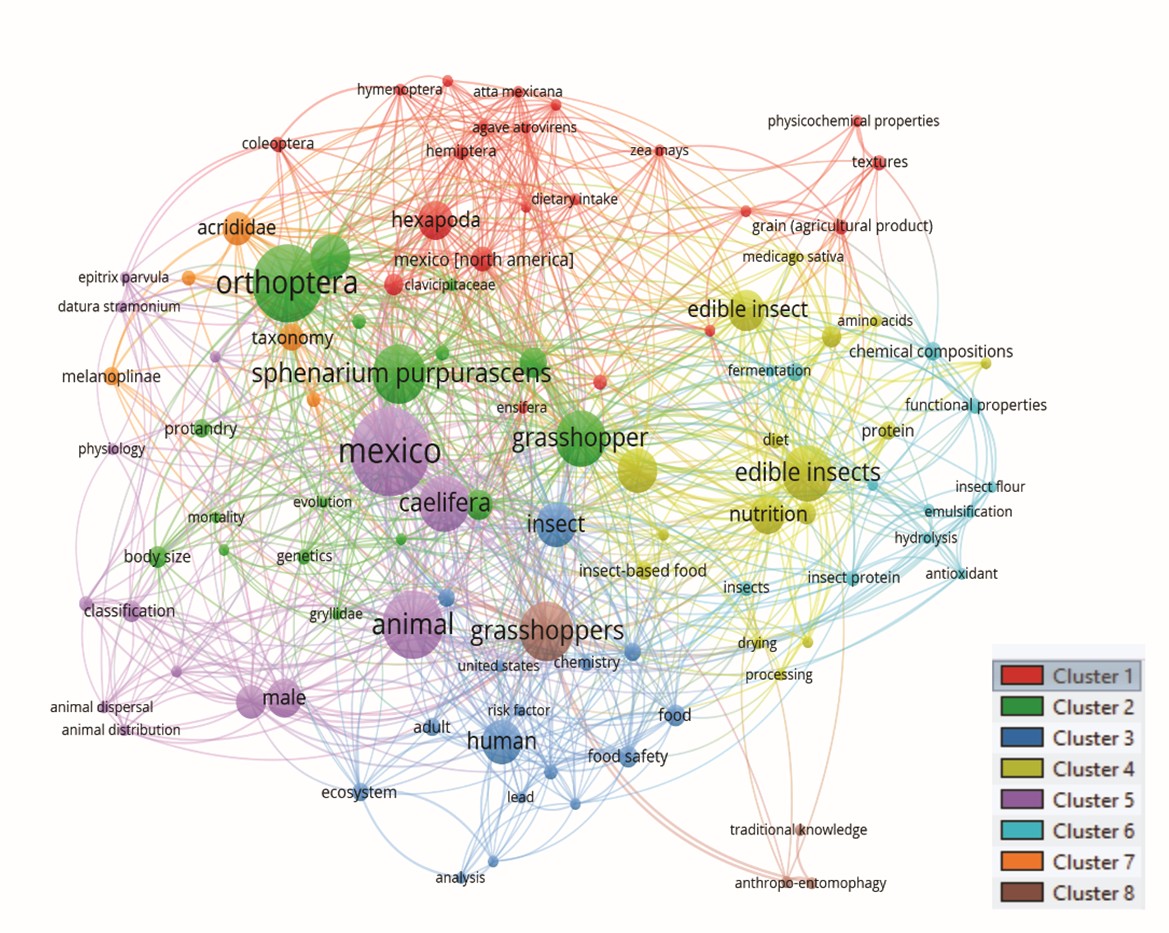
Los chapulines del orden Orthoptera forman parte de sistemas alimentarios tradicionales en distintas regiones y poseen relevancia nutricional, biocultural y económica. No obstante, la información sobre sus beneficios, riesgos y sostenibilidad se encuentra dispersa y presenta distintos niveles de evidencia. El objetivo de esta revisión fue integrar la información científica y documental sobre la composición nutricional, importancia biocultural, aprovechamiento socioeconómico, usos tradicionales, sostenibilidad, aceptación e inocuidad de los chapulines, con énfasis en Sphenarium spp. en México. Se realizó una revisión documental complementada con un análisis bibliométrico en Scopus. Se consideraron artículos originales recuperados con los términos “Sphenarium purpurascens” y “chapulines”, y los registros se analizaron con VOSviewer. Se identificaron 55 documentos sobre S. purpurascens y 10 asociados con el término chapulines. México concentró la mayor producción científica, mientras que las líneas predominantes abordaron composición química, propiedades fisicoquímicas, formulación de alimentos, nutrición, ecología y riesgos para la salud. La literatura documenta que los chapulines aportan proteínas, aminoácidos, lípidos y minerales, además de su importancia en prácticas culinarias, recolección estacional y generación de ingresos locales. Sin embargo, su composición depende de la especie, dieta, etapa de desarrollo y procesamiento. Los usos medicinales tradicionales no equivalen a eficacia clínica comprobada y el consumo requiere control de peligros microbiológicos, químicos y alergénicos. En conclusión, los chapulines pueden complementar la diversificación alimentaria y fortalecer economías locales, siempre que su aprovechamiento se base en manejo sostenible, trazabilidad, procesamiento higiénico, etiquetado y evaluación de la aceptación cultural.
Descargas
Referencias
Aguilar-Rodríguez, S. (2007). Cooking modernity: Nutrition policies, class, and gender in 1940s and 1950s Mexico City. The Americas, 64(2), 177-205. https://doi.org/10.1353/tam.2007.0128 DOI: https://doi.org/10.1353/tam.2007.0128
Aguilar-Rodríguez, S. (2008). Alimentando a la nación: género y nutrición en México (1940-1960). Revista de Estudios Sociales, 29(1), 28-41. https://journals.openedition.org/revestudsoc/18461 DOI: https://doi.org/10.7440/res29.2008.02
Aguirre-Segura, A. & Barranco, V. P. (2015). Orden Orthoptera. Revista IDE @- SEA (Ibero Diversidad Entomológica), 46(1), 1-13. https://www.researchgate.net/publication/280609212_Orden_Orthoptera
Arango-Gutiérrez, G.P. (2005). Los insectos: una materia prima alimenticia promisoria contra la hambruna. Revista Lasallista de Investigación, 2(1), 33-37. https://www.redalyc.org/pdf/695/69520106.pdf
Arya, S. S., Rookes, J. E., Cahill, D. M. & Lenka, S. K. (2021). Vanillin: A review on the therapeutic prospects of a popular flavouring molecule. Advances in Traditional Medicine, 21, 1-17. https://doi.org/10.1007/s13596-020-00531-w DOI: https://doi.org/10.1007/s13596-020-00531-w
Barbero, M. (1997). Códices etnográficos. El Códice Florentino. In: EHSEA, 14, 349-379 (Universidad de Cuenca). http://hdl.handle.net/10017/5990
Barranco, P. & Molina-Pardo, J. L. (2021). Cuticular structures in micropterous crickets (Orthoptera, Gryllidae, Petaloptilini, Gryllomorphini). Insects, 12(8), 708. https://doi.org/10.3390/insects12080708 DOI: https://doi.org/10.3390/insects12080708
Barrios-Morales, M. L., Peralta-García, X. P., Salazar, R. y Maldonado-Astudillo,Y.I. (2022). Análisis físico y químico proximal, de tres especies de insectos comestibles en Guerrero, México. Acta Agrícola y Pecuaria, 8(1), 1-8. https://doi.org/10.30973/aap/2022.8.0081019
Bernard, T. y Womeni, H. M. (2017). Entomophagy, insects as food. Insect physiology and ecology, V. D. C. Shields (Ed.). 233-249. Rijeka: IntechOpen. http://dx.doi.org/10.5772/67384 DOI: https://doi.org/10.5772/67384
Blásquez, J. R. E., Moreno, J. M. P. & Camacho, V. H. M. (2012). Could grasshoppers be a nutritive meal. Food and Nutrition Sciences. 3(2), 164-175. http://dx.doi.org/10.4236/fns.2012.32025
Broekman, H. C. H. P., Knulst, A. C., den Hartog Jager, C. F., van Bilsen, J. H. M., Raymakers, F. M. L., Kruizinga, A. G., Gaspari, M., Gabriele, C., Bruijnzeel-Koomen, C. A. F. M., Houben, G. F. & Verhoeckx, K. C. M. (2017). Primary respiratory and food allergy to mealworm. The Journal of Allergy and Clinical Immunology. 140(2), 600–603.e7. https://doi.org/10.1016/j.jaci.2017.01.035 DOI: https://doi.org/10.1016/j.jaci.2017.01.035
Brüll, F., Mensink, R. P., van den Hurk, K., Duijvestijn, A. & Plat, J. (2010). TLR2 activation is essential to induce a Th1 shift in human peripheral blood mononuclear cells by plant stanols and plant sterols. The Journal of Biological Chemistry, 285(5), 2951-2958. https://doi.org/10.1074/jbc.M109.036343 DOI: https://doi.org/10.1074/jbc.M109.036343
Buszewska-Forajta, M., Siluk, D., Daghir-Wojtkowiak, E., Sejda, A., Staśkowiak, D., Biernat, W. & Kaliszan, R. (2015). Studies of the effect of grasshopper abdominal secretion on wound healing with the use of murine model. Journal of Ethnopharmacology, 176(1), 413–423. https://doi.org/10.1016/j.jep.2015.11.004 DOI: https://doi.org/10.1016/j.jep.2015.11.004
Cartay, A., Dimitrov, V. & Feldman, M. (2020). An insect bad for agriculture but good for human consumption: The case of Rhynchophorus palmarum: A social science perspective. Edible Insects. H. Mikkola (Ed.). London: IntechOpen. https://doi.org/10.5772/intechopen.87165 DOI: https://doi.org/10.5772/intechopen.87165
Castro-López, C., Santiago-López, L., Vallejo-Cordoba, B., González-Córdova, A. F., Liceaga, A. M., García, H. S. & Hernández-Mendoza, A. (2020). An insight to fermented edible insects: A global perspective and propective. Food Research International, 137(2020), 1-11. https://doi.org/10.1016/j.foodres.2020.109750 DOI: https://doi.org/10.1016/j.foodres.2020.109750
Cerritos-Flores, R., Ponce-Reyes, R. & Rojas-García, F. (2014). Exploiting a pest insect species Sphenarium purpurascens for human consumption: Ecological, social, and economic repercussions. Journal of Insects as Food and Feed. 1(1), 75–84. https://doi.org/10.3920/JIFF2014.0013 DOI: https://doi.org/10.3920/JIFF2014.0013
Cerritos, R. & Cano-Santana, Z. (2008). Harvesting grasshoppers Sphenarium purpurascens in Mexico for human consumption: A comparison with insecticidal control for managing pest outbreaks. Crop Protection, 27(3), 473–480. https://doi.org/10.1016/j.cropro.2007.08.001 DOI: https://doi.org/10.1016/j.cropro.2007.08.001
Cerritos, R. & Klewer, M. (2015). Prehispanic agricultural practices: Using pest insects as an alternative source of protein. Animal Frontiers, 5(2), 31–36. https://doi.org/10.2527/af.2015-0017 DOI: https://doi.org/10.2527/af.2015-0017
Cheseto, X., Baleba, S. B., Tanga, C. M., Kelemu, S. & Torto, B. (2020). Chemistry and sensory characterization of a bakery product prepared with oils from African edible insects. Foods, 9(6), 800. https://doi.org/10.3390/foods9060800 DOI: https://doi.org/10.3390/foods9060800
Cheseto, X., Kuate, S.P., Tchouassi, D.P., Ndungu, M.W., Teal, P.E. & Torto, B. (2015). Potential of the desert locust Schistocerca gregaria (Orthoptera: Acrididae) as an unconventional source of dietary and therapeutic sterols. PLoS One, 10(5), e0127171. https://doi.org/10.1371/journal.pone.0127171 DOI: https://doi.org/10.1371/journal.pone.0127171
Cigliano, M. M., Braun, H., Eades, D. C. & Otte, D. (2023). Sphenarium purpurascens Charpentier, 1845. Orthoptera Species File. http://orthoptera.speciesfile.org
Cohen, J. H., Sanchez, N. D. M. & Montiel-Ishino, F. (2009). Chapulines and food choices in rural Oaxaca. Gastronomica, 9(1), 61-65. https://doi.org/10.1525/gfc.2009.9.1.61 DOI: https://doi.org/10.1525/gfc.2009.9.1.61
Comisión Nacional para el Conocimiento y Uso de la Biodiversidad (CONABIO). (2023). EncicloVida. http://www.enciclovida.mx
Cortés, O. R. L., García, V. D. B. & Carrillo, M. D. L. C. C. (2021). Uso de chapulines (Sphenarium sp.) para el enriquecimiento del pinole. En: La gastronomía como extensión del conocimiento. 1, 77-103. https://sedeturqroo.gob.mx/gastronomia/webroot/pdfs/2021-06-21%2018:25:48_doc.pdf
Costa-Neto, E. M. (2005). Entomotherapy, or the Medicinal Use of Insects. Journal of Ethnobiology, 25(1), 93–114. https://doi.org/10.2993/0278-0771(2005)25[93:EOTMUO]2.0.CO;2 DOI: https://doi.org/10.2993/0278-0771(2005)25[93:EOTMUO]2.0.CO;2
Costa-Neto, E. M., Ramos-Elorduy, J. & Pino, J. M. (2006). Los insectos medicinales de Brasil: primeros resultados. Boletín Sociedad Entomológica Aragonesa, 38, 395−414. https://www.sea-entomologia.org/Boletin38
Cruz-López, S. O., Álvarez-Cisneros, M., Domínguez-Soberanes, J., Escalona-Buendía, H.B. & Sánchez, C.N. (2022). Physicochemical and sensory characteristics of sausages made with grasshopper (Sphenarium purpurascens) flour. Foods, 11(5), 704. https://doi.org/10.3390/foods11050704 DOI: https://doi.org/10.3390/foods11050704
Das, M. & Mandal, S. (2013). Assessment of nutritional quality and anti-nutrient composition of two edible grasshoppers (Orthoptera: Acrididae) a search for new food alternative. International Journal of Medicine and Pharmaceutical Science, 3(5), 31-48. https://www.academia.edu/43517677/ASSESSMENT_OF_NUTRITIONAL_QUALITY_AND_ANTI_NUTRIENT_COMPOSITION_OF_TWO_EDIBLE_GRASSHOPPERS_ORTHOPTERA_ACRIDIDAE_A_SEARCH_FOR_NEW_FOOD_ALTERNATIVE
da Silva, L. A. J., de Oliveira, L. M., Da Rocha, M. & Prentice, C. (2020). Edible insects: An alternative of nutritional, functional and bioactive compounds. Food Chemistry, 311, 126022. https://doi.org/10.1016/j.foodchem.2019.126022 DOI: https://doi.org/10.1016/j.foodchem.2019.126022
Deroy, O., Reade, B. & Spence, C. (2015). The insectivore’s dilemma, and how to take the West out of it. Food Quality and Preference, 44, 44-55. https://doi.org/10.1016/j.foodqual.2015.02.007 DOI: https://doi.org/10.1016/j.foodqual.2015.02.007
Dev, S., Hassan, K., Claes, J., Mozahid, M.N., Khatun, H. & Mondal, M.F. (2020). Practices of entomophagy and entomotherapy in Bangladesh. Journal of Insects as Food and Feed, 6(5), 515–524. https://doi.org/10.3920/JIFF2020.0038 DOI: https://doi.org/10.3920/JIFF2020.0038
Dobermann, D., Swift, J. A. & Field, L. M. (2017). Opportunities and hurdles of edible insects for food and feed. Nutrition Bulletin, 42(4), 293–308. https://doi.org/10.1111/nbu.12291 DOI: https://doi.org/10.1111/nbu.12291
Dossey, A.T., Tatum, J.T. & McGill, W.L. (2016). Modern Insect-Based Food Industry: Current Status, Insect Processing Technology, and Recommendations Moving Forward. En Dossey, A. T., Morales-Ramos, J. A., & Rojas, M. G. (Eds.). Insects as sustainable food ingredients: Production, processing and food applications (pp.113-152). https://doi.org/10.1016/B978-0-12-802856-8.00005-3 DOI: https://doi.org/10.1016/B978-0-12-802856-8.00005-3
Ebenebe, C. I., Ibitoye, O. S., Amobi, I. M. & Okpoko, V. O. (2020). African Edible Insect Consumption Market. In: Adam Mariod, A. (Eds) African edible insects as alternative source of food, oil, protein and bioactive components. Springer, Cham. (1 ed., Vol.VI, pp.19-51). https://doi.org/10.1007/978-3-030-32952-5_2 DOI: https://doi.org/10.1007/978-3-030-32952-5_2
EFSA Scientific Committee. (2015). Risk profile related to production and consumption of insects as food and feed. EFSA Journal, 13(10), 42-46. https://doi.org/10.2903/j.efsa.2015.4257 DOI: https://doi.org/10.2903/j.efsa.2015.4257
Etemadi, A., Sinha, R., Ward, M. H., Graubard, B. I., Inoue-Choi, M., Dawsey, S. M. & Abnet, C. C. (2017). Mortality from different causes associated with meat, heme iron, nitrates, and nitrites in the NIH-AARP Diet and Health Study: Population based cohort study. BMJ (Clinical research ed), 357, j1957. https://doi.org/10.1136/bmj.j1957 DOI: https://doi.org/10.1136/bmj.j1957
Feng, Y., Chen, X. M., Zhao, M., He, Z., Sun, L., Wang, C. Y. & Ding, W.F. (2018). Edible insects in China: Utilization and prospects. Insect Science, 25(2), 184-198. https://doi.org/10.1111/1744-7917.12449 DOI: https://doi.org/10.1111/1744-7917.12449
Finke, M. D. & Oonincx, D. D. (2014). Insects as food for insectivores. In J. Shapiro-Ilan Morales-Ramos, G. Rojas, & D. I. Shapiro-Ilan (Eds.), Mass Production of Beneficial Organisms: Invertebrates and Entomopathogens. Cap. 17, 583-616. Academic Press. https://doi.org/10.1016/B978-0-12-391453-8.00017-0 DOI: https://doi.org/10.1016/B978-0-12-391453-8.00017-0
Gasco, L., Biancarosa, I. y Liland, NS (2020). De residuos a alimento: Una revisión del conocimiento reciente sobre insectos como productores de proteínas y grasas para piensos. Current Opinion in Green and Sustainable Chemistry, 23, 67-79. https://doi.org/10.1016/j.cogsc.2020.03.003 DOI: https://doi.org/10.1016/j.cogsc.2020.03.003
Gerber, P. J., Steinfeld, H., Henderson, B., Mottet, A., Opio, C., Dijkman, J., Falcucci, A., Tempio, G. (2013). Tackling climate change through livestock: A global assessment of emissions and mitigation opportunities. Food and Agriculture Organization of the United Nations (FAO), Rome. https://www.fao.org/4/i3437e/i3437e.pdf
Ghosh, S., Haldar, P. & Mandal, D. K. (2016). Evaluation of nutrient quality of a short horned grasshopper, Oxya hyla hyla Serville (Orthoptera: Acrididae) in search of new protein source. Journal of Entomology and Zoology Studies, 4(1), 193-197. https://www.entomoljournal.com/archives/?year=2016&vol=4&issue=1&ArticleId=806
Gómez-Cortés, P., de la Fuente, M. Á. & Juárez, M. (2019). Ácidos grasos trans y ácido linoleico conjugado en alimentos: origen y propiedades biológicas. Nutrición Hospitalaria, 36(2), 479-486. https://doi.org/10.20960/nh.2466 DOI: https://doi.org/10.20960/nh.2466
Grageda Grageda, José, Ruiz Corral, José Ariel, Jiménez Lagunes, Alejandro, & Fu Castillo, Agustín Alberto. (2014). Influencia del cambio climático en el desarrollo de plagas y enfermedades de cultivos en Sonora. Revista Mexicana de Ciencias Agrícolas, 5(10), 1913-1921. https://doi.org/10.29312/remexca.v0i10.1026 DOI: https://doi.org/10.29312/remexca.v0i10.1026
Halloran, A., Flore, R., Vantomme, P., & Roos, N. (Eds.). (2018). Edible insects in sustainable food systems. Springer. Belluco, S, Mantovani, A., & Ricci A. (Ed.) (2018). Edible insects in a food safety perspective. https://doi.org/10.1007/978-3-319-74011-9 DOI: https://doi.org/10.1007/978-3-319-74011-9
Harvey, J. A., Heinen, R., Gols, R. & Thakur, M. P. (2020). Climate change-mediated temperature extremes and insects: From outbreaks to breakdowns. Global Change Biology, 26(12), 6685–6701. https://doi.org/10.1111/gcb.15377 DOI: https://doi.org/10.1111/gcb.15377
Hopkins, T. L. & Ahmad, S. A. (1991). Flavonoid wing pigments in grasshoppers. Experientia, 47(1), 1089-1091. https://doi.org/10.1007/BF01923349 DOI: https://doi.org/10.1007/BF01923349
Huerta, A. J., Espinoza, F., Téllez-Jurado, A. & Maqueda, A. P. (2014). Control biológico del chapulín en México. BioTecnología, 18(1), 28-49. https://smbb.mx/revista-biotecnologia-2014-vol-18-no-1/
Hurd, K. J., Shertukde, S., Toia, T., Trujillo, A., Peréz, R., Larom, D., Love, J., Changqi, L. (2019). The cultural importance of edible insects in Oaxaca, Mexico. Annals of the Entomological Society of America, 112(6), 552-559. https://doi.org/10.1093/aesa/saz018 DOI: https://doi.org/10.1093/aesa/saz018
Hyun, S. H., Kwon, K. H., Park, K. H., Jeong, H.C., Kwon, O., Tindwa, H., Han, Y.S. (2012). Evaluation of nutritional status of an edible grasshopper, Oxya chinensis formosana. Entomological Research, 42(5), 284-290. https://doi.org/10.1111/j.1748-5967.2012.00469.x DOI: https://doi.org/10.1111/j.1748-5967.2012.00469.x
Ibarra-Herrera, C. C., Acosta-Estrada, B., Chuck-Hernández, C., Serrano- Sandoval, SN, Guardado-Félix, D., Pérez-Carillo, E. (2020). Nutritional content of edible grasshopper (Sphenarium purpurascens) fed on alfalfa (Medicago sativa) and maize (Zea mays). CyTA-Journal of Food, 18(1), 257-263. https://doi.org/10.1080/19476337.2020.1746833 DOI: https://doi.org/10.1080/19476337.2020.1746833
Instituto Nacional de Estadística y Geografía (Inegi). (2025). Estadísticas de defunciones registradas. https://www.inegi.org.mx/contenidos/saladeprensas/boletines/2025/edr/EDR2024_CP_ene-dic-pdf
Jorand, B. (2008). Formas de transformación del conocimiento de la medicina tradicional en los pueblos nahuas del municipio de Hueyapan, Sierra Norte de Puebla. Cuicuilco, 15(44), 181-196. https://revistas.inah.gob.mx/index.php/cuicuilco/article/view/4264/4219
Kinyuru, J. N., Kenji, G. M., Njoroge, S. M., & Ayieko, M. (2010). Effect of processing methods on the in vitro protein digestibility and vitamin content of edible winged termite (Macrotermes subhylanus) and grasshopper (Ruspolia differens). Food and Bioprocess Technology, 3(1), 778-782. https://link.springer.com/article/10.1007/s11947-009-0264-1 DOI: https://doi.org/10.1007/s11947-009-0264-1
Kleden, Y. L., Mukkun, L., Ndapamuri, M. H. (2023). The migratory locust (Locusta migratoria) as a potential source of protein and biopolymer compounds in the future. Biodiversitas Journal of Biological Diversity, 24(11). https://doi.org/10.13057/biodiv/d241117 DOI: https://doi.org/10.13057/biodiv/d241117
La Barbera, F., Verneau, F., Amato, M., & Grunert, K. (2018). Understanding Westerners’ disgust for the eating of insects: The role of food neophobia and implicit associations. Food Quality and Preference, 64(1), 120-125. https://doi.org/10.1016/j.foodqual.2017.10.002 DOI: https://doi.org/10.1016/j.foodqual.2017.10.002
Landero, T., Ramos-Elorduy, H. Oliva, M.E. Galindo, O. Leiva, H. Lee, y Lee, y Murguía. (2012). Insectos comestibles y medicinales en el municipio de Ixhuatlancillo Veracruz. Entomología Mexicana, 11(1), 310-314.
Larouche, J., Campbell, B., Hénault-Éthier, L., Banks, I.J., Tomberlin, J.K., Preyer, C., Deschamps, M.H., Vandenberg, G.W. (2023). The edible insect sector in Canada and the United States. Animal Frontiers, 13(4), 16-25. https://doi.org/10.1093/af/vfad047 DOI: https://doi.org/10.1093/af/vfad047
Lesnik, J. J. (2017). Not just a fallback food: Global patterns of insect consumption related to geography, not agriculture. American Journal of Human Biology, 29(2), e22976. https://doi.org/10.1002/ajhb.22976 DOI: https://doi.org/10.1002/ajhb.22976
Loizou, S., Lekakis, I., Chrousos, G. P., Moutsatsou P. (2010). Beta-sitosterol exhibits anti-inflammatory activity in human aortic endothelial cells. Molecular Nutrition & Food Research, 54(4), 551–558. https://doi.org/10.1002/mnfr.200900012 DOI: https://doi.org/10.1002/mnfr.200900012
López, R. (2020). Insectos, ingrediente clave de la gastronomía mexicana. GACETA UNAM. 5 (125), 7. https://www.gaceta.unam.mx/insectos-ingrediente-clave-de-la-gastronomía-mexicana/
Marín-Morales, M. S., Ibarra-Herrera, C. C., Luna-Vital, D. A., Monribot-Villanueva, J.L., Guerrero- Analco, J.A. (2022). Biological activity of extracts and hydrolysates from early-and adult-stage edible grasshopper Sphenarium purpurascens. Frontiers in Nutrition, 9(1), 1-15. https://doi.org/10.3389/fnut.2022.1028543 DOI: https://doi.org/10.3389/fnut.2022.1028543
Mariutti, L. R. B., Rebelo, K. S., Bisconsin-Junior, A., Santos de Morais, J., Magnani, M., Rodrigues Maldonade, I., Nuno Rodrigo Madeira, N., Tiengo, A., Roberto Maróstica, M., Betim Cazarin., C.B. (2021). The use of alternative food sources to improve health and guarantee access and food intake. Food Research International, 149(1), 1-11. https://doi.org/10.1016/j.foodres.2021.110709 DOI: https://doi.org/10.1016/j.foodres.2021.110709
Mazimba, O. (2017). Umbelliferone: Sources, chemistry and bioactivities review. Bulletin of Faculty of Pharmacy, Cairo University, 55(2), 223-232. https://doi.org/10.1016/j.bfopcu.2017.05.001 DOI: https://doi.org/10.1016/j.bfopcu.2017.05.001
Medrano-Nava, M.T; Valdivia-Nájar,C. G., Moreno- Villet, L. (2024). Insectos comestibles como alimento a futuro y sus retos. Enfoques Transdisciplinarios: Ciencia y Sociedad, 2(1), 75-86. https://revistaenfoques.ciatej.mx/index.php/revistaenfoques/article/view/28
Melo, V., García, M., Sandoval, H., Quirino-Barreda, C.T., Sanchez-Herrera, K. (2011). Chemical composition and amino acids content of five species of edible grasshoppers from Mexico. Emirates Journal of Food and Agriculture, 27(8), 654-658. https://doi.org/10.9755/ejfa.2015.04.093 DOI: https://doi.org/10.9755/ejfa.2015.04.093
Meyer-Rochow, V. B., Gahukar, R. T., Ghosh, S., & Jung, C. (2021). Chemical Composition, Nutrient Quality and Acceptability of Edible Insects Are Affected by Species, Developmental Stage, Gender, Diet, and Processing Method. Foods, 10(5), 1036. https://doi.org/10.3390/foods10051036 DOI: https://doi.org/10.3390/foods10051036
Mishyna, M., Martinez, J. J. I., Chen, J., Benjamin, O. (2019). Extraction, characterization and functional properties of soluble proteins from edible grasshopper (Schistocerca gregaria) and honey bee (Apis mellifera). Food Research International, 116(1), 697–706. https://doi.org/10.1016/j.foodres.2018.08.098 DOI: https://doi.org/10.1016/j.foodres.2018.08.098
Molina, A. I. B. (2020). Análisis químico proximal de Corydalus sp. y su comparación con otros insectos comestibles. Inventio, la génesis de la cultura en Morelos, 15(37), 1-9 https://doi.org/10.30973/inventio/2019.15.37/6 DOI: https://doi.org/10.30973/inventio/2020.15.37/6
Neveu, V., Pérez-Jiménez, J., Vos, F., Crespy, V., Chaffaut, L., Mennen, L., Knox, C., Eisner, R., Cruz, J., Wishart, D., Scalbert, A. (2010). Phenol-explorer: An online comprehensive database on polyphenol contents in foods. Database, 2010(1), 1-9. https://doi.org/10.1093/database/bap024 DOI: https://doi.org/10.1093/database/bap024
Nyangena, D.N, Kinyuru, J., Imathiu, S. (2020). Climate change: a natural streamliner towards entomophagy? International Journal of Tropical Insect Science, 41(1), 2133-2147. https://doi.org/10.1007/s42690-020-00292-8 DOI: https://doi.org/10.1007/s42690-020-00292-8
Ochieng, B. O., Anyango, J. O., Nduko, J. M., Cheseto, X., Mudalungu, C. M., Khamis, F. M., Ghemoh, C. J., Egonyu, P. J., Subramanian, S., Nakimbugwe, D., Ssepuuya, G., & Tanga, C. M. (2022). Dynamics in nutrients, sterols and total flavonoid content during processing of the edible Long-Horned grasshopper (Ruspolia differens Serville) for food. Food Chemistry, 383(2022), 1-9. https://doi.org/10.1016/j.foodchem.2022.132397 DOI: https://doi.org/10.1016/j.foodchem.2022.132397
Olivadese, M., y Dindo, M.L. (2023). Edible Insects: A Historical and Cultural Perspective on Entomophagy with a Focus on Western Societies. Insects, 14(8), 1-16. https://doi.org/10.3390/insects14080690 DOI: https://doi.org/10.3390/insects14080690
Omuse, E. R., Tonnang, H. E. Z., Yusuf, A. A., Machekano, H., Egonyu, J. P., Kimathi, E., Mohamed, S. F., Kassie, M., Subramanian, S., Onditi, J., Mwangi, S., Ekesi, S., & Niassy, S. (2024). The global atlas of edible insects: analysis of diversity and commonality contributing to food systems and sustainability. Scientific Reports, 14(1), 5045. https://doi.org/10.1038/s41598-024-55603-7 DOI: https://doi.org/10.1038/s41598-024-55603-7
Oonincx, D. G. A. B., & Van der Poel, A. F. B. (2011). Effects of diet on the chemical composition of migratory locusts (Locusta migratoria). Zoo Biology, 30(1), 9-16. https://doi.org/10.1002/zoo.20308 DOI: https://doi.org/10.1002/zoo.20308
Oonincx, D. G., & De Boer, I. J. (2012). Environmental impact of the production of mealworms as a protein source for humans–a life cycle assessment. Plos One, 7(12), 1-5. https://doi.org/10.1371/journal.pone.0051145 DOI: https://doi.org/10.1371/journal.pone.0051145
Ordoñez-Araque, R., Quishpillo-Miranda, N. & Ramos-Guerrero, L. (2022). Edible Insects for Humans and Animals: Nutritional Composition and an Option for Mitigating Environmental Damage. Insects, 13(10), 944. https://doi.org/10.3390/insects13100944 DOI: https://doi.org/10.3390/insects13100944
Pal, D. & Dubey, P. (2013). Flavonoids: A powerful and abundant source of antioxidants. International Journal of Pharmacy and Pharmaceutical Sciences, 5(3), 95–98. https://innovareacademics.in/journal/ijpps/Vol5Issue3/7048.pdf?srsltid=AfmBOopfpjzRF-6e4aFO43QuaqSnbICkMjV2eFYjel55_b_UHyvw5riH
Pali-Schöll, I., Binder, R., Moens, Y., Y., Polesny, F. & Monsó, S. (2019). Edible insects–defining knowledge gaps in biological and ethical considerations of entomophagy. Critical Reviews in Food Science and Nutrition, 59(17), 2760–2771. https://doi.org/10.1080/10408398.2018.1468731 DOI: https://doi.org/10.1080/10408398.2018.1468731
Palop-Gómez, A., Rodríguez Lázaro, D., Santos Buelga, J. Á. (2018). Informe del Comité Científico de la Agencia Española de Consumo, Seguridad Alimentaria y Nutrición (AECOSAN) en relación a los riesgos microbiológicos y alergénicos asociados al consumo de insectos. Revista del Comité Científico, 27(1), 11-40. https://www.aesan.gob.es/AECOSAN/docs/documentos/seguridad_alimentaria/evaluacion_riesgos/informes_comite/CONSUMO_INSECTOS.pdf
Piña-Domínguez, I. A., Ruiz-May, E., Hernández-Rodríguez, D., Zepeda, R.C. & Melgar-Lalanne, G. (2022). Environmental effects of harvesting some Mexican wild edible insects: An overview. Frontiers in Sustainable Food Systems, 6(1), 1-11. https://doi.org/10.3389/fsufs.2022.1021861 DOI: https://doi.org/10.3389/fsufs.2022.1021861
Pino-Moreno, J. M. & Blasquez, J. R. E. (2021). Taxonomic analysis of some edible insects from the state of Michoacán, Mexico. Frontiers in Veterinary Science, 8(1), 1-10. https://doi.org/10.3389/fvets.2021.629194 DOI: https://doi.org/10.3389/fvets.2021.629194
Pino-Moreno, J. M. & Reyes-Prado, H. (2020). Commerce of edible insects in the state of Morelos, Mexico. Journal of Insect Science, 20(5),1-7. https://doi.org/10.1093/jisesa/ieaa106 DOI: https://doi.org/10.1093/jisesa/ieaa106
Pino-Moreno, J. M., Ramos-Elorduy, J. & Costa-Neto, E. M. (2006). Los insectos comestibles comercializados en los mercados de Cuautitlán de Romero Rubio, Estado de México, México. Sitientibus Série Ciencias Biológicas, 6(1), 58-64. https://doi.org/10.13102/scb8148 DOI: https://doi.org/10.13102/scb8148
Pilcher, J. M. (2018). The land of seven moles: Mexican culinary nationalism in an age of multiculturalism. Food, Culture & Society, 21(5), 637-653. https://doi.org/10.1080/15528014.2018.1516404 DOI: https://doi.org/10.1080/15528014.2018.1516404
Pulido Blanco, V. C., González Chavarro, Tapia Polanco, Y. M. y Celis Ruiz, X, M. 2020. Insectos: Recursos del pasado que podrían ser una solución nutricional para el futuro. Avances de Investigación Agropecuaria, 24(2), 81-100. https://www.redalyc.org/journal/837/83765240007/html/
Ramos-Elorduy, J. e Pino, J. (1988). The utilization of insects in the empirical medicine of ancient Mexicans. Journal of Ethnobiology, 8(2), 195-202. https://ethnobiology.org/sites/default/files/pdfs/JoE/8-2/ConconiMoreno1988.pdf
Ramos-Elorduy, J. y Pino, M.J.M. (1998) Insectos Comestibles del Estado de México. Anales del Instituto de Biología. Serie Zoología, 69(1), 65-104. https://www.redalyc.org/pdf/458/45869106.pdf
Ramos-Elorduy, J. (2004). La etnoentomología en la alimentación, la medicina y el reciclaje. In: J. E. Llorente-Bousquets., J. J. Morrone, O. Yañez e I. F.Vargas, Eds, Biodiversidad, Taxonomía y Biogeografía de Artrópodos de México: Hacia una Síntesis de su Conocimiento. UNAM, Facultad de Ciencias, México. https://biodiversidad.gob.mx/publicaciones/librosDig/pdf/Artropodos%20IV_4-pdf
Ramos-Elorduy, J. & Pino-Moreno, J.M. (2004). Los coleoptera comestibles de México. Anales del Instituto de Biología. Serie Zoología, 75(1), 149-183. https://www.redalyc.org/pdf/458/45875107.pdf
Ramos-Elorduy, J. (2009). Anthropo-entomophagy: Cultures, evolution and sustainability. Entomological Research, 39(5), 271–288. https://doi.org/10.1111/j.1748-5967.2009.00238.x DOI: https://doi.org/10.1111/j.1748-5967.2009.00238.x
Ramos-Elorduy, J., Moreno, J. M. P. & Camacho, V. H. M. (2012). Could grasshoppers be a nutritive meal? Food and Nutrition Sciences, 3(1), 164–175. https://doi.org/10.4236/fns.2012.32025 DOI: https://doi.org/10.4236/fns.2012.32025
Ramos-Elorduy, J., Pino, J. M. & Conconi, M. (2006). Ausencia de una reglamentación y normalización de la explotación y comercialización de insectos comestibles en México. Folia Entomológica Mexicana, 45(3), 291-318. https://www.redalyc.org/articulo.oa?id=42445304
Rodríguez-Miranda, J., Alcántar-Vázquez, J. P., Zúñiga-Marroquín, T., Juárez-Barrientos, J. (2019). Insects as an alternative source of protein: A review of the potential use of grasshopper (Sphenarium purpurascens Ch.) as a food ingredient. European Food Research and Technology, 245(12), 2613-2620. https://doi.org/10.1007/s00217-019-03383-0 DOI: https://doi.org/10.1007/s00217-019-03383-0
Rostro, B. R., Salazar, B. Q., Ramos-Elorduy, J., Pino-Moreno, J., Angeles-Campos, S.C., García Pérez, A., Barrera-García, D.B. (2012). Análisis químico y nutricional de tres insectos comestibles de interés comercial en la zona arqueológica del municipio de San Juan Teotihuacán y en Otumba, en el estado de México. Interciencia, 37(12), 914-920. https://www.interciencia.net/volumen-37/numero-12-5/
Sahagún, Fray Bernardino de. Florentine Codex. (1950). General History of the Things of New Spain. 1953-1982 (C. E. Dibble & A. J. O. Anderson, Eds.). University of Utah. https://archive.org/details/generalhistoryof0000bern
Sánchez-Bayo, F., & Wyckhuys, K. A. 2019. Worldwide decline of the entomofauna: A review of its drivers. Biological Conservation, 232(1), 8-27. https://doi.org/10.1016/j.biocon.2019.01.020 DOI: https://doi.org/10.1016/j.biocon.2019.01.020
Shelomi, M. (2015). Why we still don't eat insects: Assessing entomophagy promotion through a diffusion of innovations framework. Trends in Food Science & Technology, 45(2), 311-318. https://doi.org/10.1016/j.tifs.2015.06.008 DOI: https://doi.org/10.1016/j.tifs.2015.06.008
Schulze, M. B. & Hu, F. B. (2005). Primary prevention of diabetes: what can be done and how much can be prevented. Annual Review of Public Health, 26(1), 445-467. https://doi.org/10.1146/annurev.publhealth.26.021304.144532 DOI: https://doi.org/10.1146/annurev.publhealth.26.021304.144532
Skotnicka, M., Karwowska, K., Kłobukowski, F., F., Borkowska, A. & Pieszko, M. (2021). Possibilities of the development of edible insect-based foods in Europe. Foods, 10(4), 766. https://doi.org/10.3390/foods10040766 DOI: https://doi.org/10.3390/foods10040766
Sosa-Marcos, Y., Pacheco, R. P., Pérez, G. E. G. Manzanero, G. I. y Rodríguez-Ortiz, G. (2015). Conocimiento tradicional y valor cultural de Sphenarium spp. en Valles Centrales de Oaxaca. Revista Mexicana de Agroecosistemas, 2(2), 75-86. https://revistaremaeitvo.mx/index.php/remae/article/view/311
Sun, R., Sun, X. F., Wang, S. Q. Zhu, W. & Wang, X.Y. (2002). Ester and ether linkages between hydroxycinnamic acids and lignins from wheat, rice, rye, and barley straws, maize stems, and fast-growing poplar wood. Industrial Crops and Products, 15(3), 179-188. https://doi.org/10.1016/S0926-6690(01)00112-1 DOI: https://doi.org/10.1016/S0926-6690(01)00112-1
Sun-Waterhouse, D., Waterhouse, G. I., You, L., Zhang, J., Liu, Y., Ma, L., Gao, J. & Dong, Y. (2016). Transforming insect biomass into consumer wellness foods: A review. Food Research International, 89(1), 129–151. https://doi.org/10.1016/j.foodres.2016.10.001 DOI: https://doi.org/10.1016/j.foodres.2016.10.001
Tan, H. S. G., Verbaan, Y. T. & Stieger, M. (2017). How will better products improve the sensory-liking and willingness to buy insect-based foods? Food Research International, 92(1), 95-105. https://doi.org/10.1016/j.foodres.2016.12.021 DOI: https://doi.org/10.1016/j.foodres.2016.12.021
Torres, F. y Rojas, A. (2018). Obesidad y salud pública en México: transformación del patrón hegemónico de oferta-demanda de alimentos. Problemas del Desarrollo, 49(193), 145-169. https://doi.org/10.22201/iiec.20078951e.2018.193.63185 DOI: https://doi.org/10.22201/iiec.20078951e.2018.193.63185
Van, Huis. A. (2003). Insects as food in sub-Saharan Africa. International Journal of Tropical Insect Science, 23(3), 163-185. https://doi.org/10.1017/S1742758400023572 DOI: https://doi.org/10.1017/S1742758400023572
Van, Huis. A., Itterbeeck, J. V., Klunder, H., Mertens, E., Halloran, A., Muir, G. & Vantomme, P. (2013). Edible insects: Future prospects for food and feed security. FAO. https://www.fao.org/4/i3253e/i3253e.pdf
Vanegas, A. A. M., & Gutiérrez, L. F. (2016). Carne equina: producción, consumo y valor nutricional. CES Medicina Veterinaria y Zootecnia, 11(3), 86-103. DOI: https://doi.org/10.21615/cesmvz.11.3.8
Van Eck, N. J. & Waltman, L. (2010). Software survey: VOSviewer, a computer program for bibliometric mapping. Scientometrics, 84(2), 523–538. https://doi.org/10.1007/s11192-009-0146-3 DOI: https://doi.org/10.1007/s11192-009-0146-3
Varelas, V. (2019). Food wastes as a potential new source for edible insect mass production for food and feed: A review. Fermentation, 5(3), 81. https://doi.org/10.3390/fermentation5030081 DOI: https://doi.org/10.3390/fermentation5030081
Verhoeckx, K. C., van Broekhoven, S., den Hartog-Jager, C. F., Gaspari, M., de Jong, G. A., Wichers, H. J., van Hoffen, E., Houben, G. F. & Knulst, A. C. (2014). House dust mite (Der p 10) and crustacean allergic patients may react to food containing yellow mealworm proteins. Food and Chemical Toxicology, 65(1), 364-373. https://doi.org/10.1016/j.fct.2013.12.04 DOI: https://doi.org/10.1016/j.fct.2013.12.049
Verkerk, M. C., Tramper, J., Van Trijp, J. C. M. & Martens, D. E. (2007). Insect cells for human food. Biotechnology Advances, 25(2), 198-202. https://doi.org/10.1016/j.biotechadv.2006.11.004 DOI: https://doi.org/10.1016/j.biotechadv.2006.11.004
Verneau, F., La Barbera, F., Kolle, S., Amato, M., Del Giudice, T. & Grunert, K. (2016). The effect of communication and implicit associations on consuming insects: An experiment in Denmark and Italy. Appetite, 106(1), 30-36. https://doi.org/10.1016/j.appet.2016.02.006 DOI: https://doi.org/10.1016/j.appet.2016.02.006
Wang, X-D. (2012). Lycopene metabolism and its biological significance. The American Journal of Clinical Nutrition, 96(5), 1214S–1222S. https://doi.org/10.3945/ajcn.111.032359 DOI: https://doi.org/10.3945/ajcn.111.032359
Woyengo, T. A., Ramprasath, V. R. & Jones, P. J. H. (2009). Anticancer effects of phytosterols. European Journal of Clinical Nutrition, 63(7), 813–820. pmid:19491917. https://doi.org/10.1038/ejcn.2009.29 DOI: https://doi.org/10.1038/ejcn.2009.29
Wu, K., Li, W., Song, J. & Li, T. (2015). Production, purification, and identification of cholest-4-en-3-one produced by cholesterol oxidase from Rhodococcus sp. in aqueous/organic biphasic system. Biochemistry Insights, 8(1), 1-8. https://doi.org/10.4137/BCI.S21580 DOI: https://doi.org/10.4137/BCI.S21580
Yen, A. L. (2015). Insects as food and feed in the Asia Pacific region: Current perspectives and future directions. Journal of Insects as Food and Feed, 1(1), 33–55. https://doi.org/10.3920/JIFF2014.0017 DOI: https://doi.org/10.3920/JIFF2014.0017
Yin, W., Liu, J., Liu, H. & Lv, B. (2017). Nutritional value, food ingredients, chemical and species composition of edible insects in China. In: H. Mikkola (editors), Future Foods, 27-53. Rijeka: Intech Open. https://doi.org/10.5772/intechopen.70085 DOI: https://doi.org/10.5772/intechopen.70085
Zamudio-Flores, P. B., Hernández-Gonzaléz, M. & García-Cano, V. G. (2019). Food supplements from a Grasshopper: A developmental stage-wise evaluation of amino acid profile, protein and vitamins in Brachystola magna (Girard). Emirates Journal of Food and Agriculture, 31(7), 561-568. https://doi:10.9755/ejfa.2019.v31.i7.1989 DOI: https://doi.org/10.9755/ejfa.2019.v31.i7.1989
Archivos adicionales
Publicado
Número
Sección
Licencia
Derechos de autor 2026 Revista Mexicana de Agroecosistemas

Esta obra está bajo una licencia internacional Creative Commons Atribución-NoComercial 4.0.
La revista utiliza la versión CC BY-NC 4.0 del Creative Commonds, donde el usuario es libre de compartir, copiar y redistribuir el material en cualquier medio o formato; adaptar, remezclar, transformar y construir a partir del material. Estas libertades se sujetan a los términos siguientes.
- Atribución, los autores conservarán el reconocimiento moral de su obra y serán identificados como responsables intelectuales de los trabajos publicados. Al aceptar la publicación, los autores otorgarán a la RMAE los derechos necesarios para la edición, publicación, difusión, preservación digital e indexación de los trabajos, manteniendo siempre el reconocimiento de autoría correspondiente.
- Los materiales publicados podrán utilizarse libremente para fines no comerciales, incluyendo: docencia y actividades educativas, investigación científica y tecnológica, elaboración de tesis, proyectos académicos y trabajos de divulgación, capacitación profesional, consulta institucional y preservación digital y de archivos.
- No se permitirá que los contenidos sean utilizados con fines comerciales directos o indirectos sin autorización previa y por escrito de la revista y de los titulares de los derechos correspondientes. Se consideran usos comerciales: venta de artículos o compilaciones, inclusión del contenido en productos o servicios de pago, comercialización de bases de datos que incorporen los materiales publicados, uso publicitario o promocional con fines lucrativos, entre otros.
- Toda reutilización de los contenidos deberá: citar adecuadamente a los autores y debe incluir el título del artículo, mencionar el nombre de la revista, incorporar el volumen, número, año, DOI y mantener la referencia a la publicación original. La omisión deliberada de la atribución correspondiente constituirá una violación a los derechos de autor y a la ética académica de la revista.
- El usuario acepta y acuerda estar obligado por los términos y condiciones de esta Licencia Internacional Pública de Atribución/Reconocimiento-NoComercial 4.0 de Creative Commons ("Licencia Pública").
- La revista utiliza el accesoabierto gratuito y no restringido por suscripción. De tal manera, que se pone a disposición de los autores, los metadatos, bases de datos, datos de descarga, uso y citación para facilitar su disponibilidad a las herramientas informáticas que calculan las métricas alternativas del impacto.
- Se aplican buenas prácticas del uso del Open Journal System de acuerdo al “Manual de indización en OJS: buenas prácticas para la región latinoamericana”, 2ª. edición (Flores-Chávez et al., 2023).
- En caso de existir una impugnación con el contenido o la autoría del manuscrito, la responsabilidad -económica y jurídica- será exclusivamente de los autores, relevándola del Tecnológico Nacional de México, Campus Valle de Oaxacay de la Revista Mexicana de Agroecosistemas, ante cualquier demanda o reclamación que llegase a formular alguna persona física o moral que se considere con derecho sobre el manuscrito.
- Los nombres y las direcciones de correo electrónico introducidos en esta revista se usarán exclusivamente para los fines establecidos en ella y no se proporcionarán a terceros o para su uso con otros fines.
Cómo citar